
Complementary community-based models
In the West of France, this initiative is led by three organisations which, whilst sharing the same aim of bridging the digital divide, are implementing models tailored to their respective regions:
- Breizh-IX In Rennes, the pioneer is focusing on establishing a comprehensive network of data centres across the metropolitan area [1].
- Ouest.Network in Nantes, combines traffic exchange (IXP) and network access (NAP – Network Access Point), with a strong focus on the technical development of the sector [2].
- BrestIX In Brest, the youngest of the group is drawing on a strong public-private partnership to prepare for the arrival of major international infrastructure projects [3].
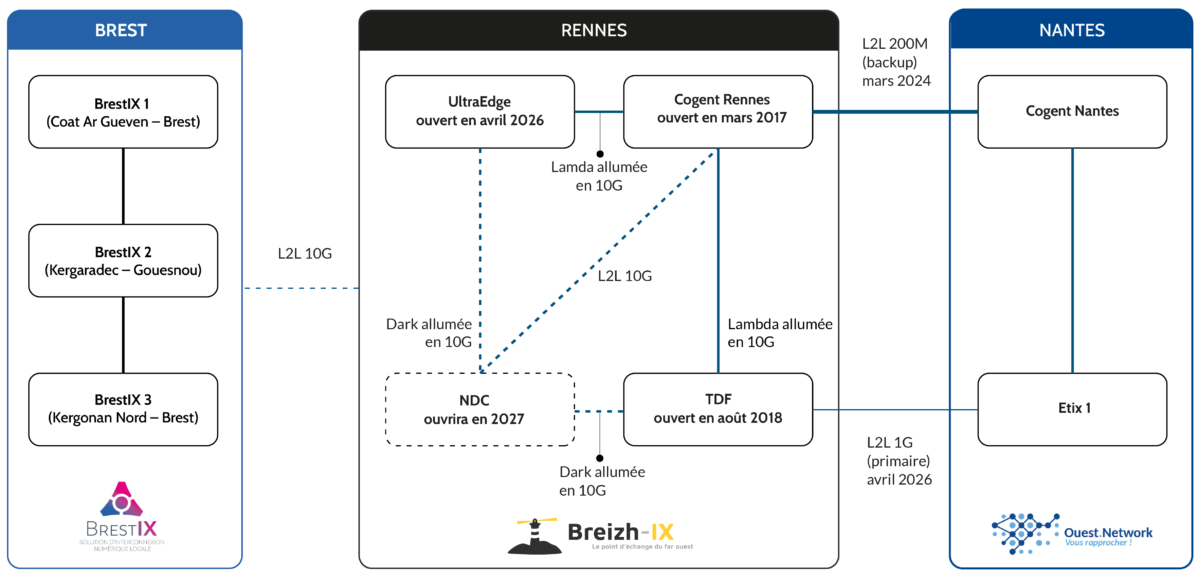
These initiatives form part of a national drive supported by FRNIX (owner of France-IX), which runs a working group dedicated to «IXPs & Regions», promoting the sharing of expertise and the joint development of interconnection strategies in France [4].
2. Breizh-IX: towards a new network for the Rennes conurbation
Founded in 2017, the non-profit organisation Breizh-IX is a perfect example of the level of maturity a regional IXP can achieve. Run entirely by volunteers, led by Alarig Le Lay, it provides a neutral exchange point open to all network operators (open peering policy).
Breizh-IX’s (AS206165) strategy is based on maintaining a physical presence as close as possible to local stakeholders, namely within data centres. The IXP currently operates at three major sites:
- The data centre Cogent in Rennes (since 2017).
- Le ProxyCenter TDF in Cesson-Sévigné (since 2018), recently connected via a 10G wave [5].
- Le datapole Ultraedge in Rennes, currently being rolled out [2].
But the ambition doesn’t stop there. With the announced presence within the data centre NDC (National Data Centre) Scheduled for 2026, Breizh-IX will set up a fourth point of presence (PoP) there. If this project goes ahead, Rennes is set to become the first urban area in France to have a comprehensive network connecting all its commercial data centres via a local IXP.
This success is the result of strong regional collaboration. The Rennes metropolitan area is actively supporting this initiative, notably by providing one of the fibre-optic links between the sites, demonstrating the public authorities’ understanding of the strategic importance of this infrastructure.
In January 2026, the association organised its first community event, an «aPEERo» (a format pioneered by FRNIX), which brought together around sixty local stakeholders for a particularly lively evening of discussion. The association also plays an active role in the working group for regional community-run IXPs, led by FRNIX.
3. Ouest.Network: Driving the Nantes sector forward
In Nantes, the Ouest.Network association has been rolling out a metropolitan interconnection hub since 2020, which is located in the Cogent and Etix #1 (Carquefou) data centres.
Ouest.Network stands out for its dual role as both an IXP and a NAP. This marketplace not only enables traffic to be exchanged free of charge, but also allows users to buy or sell internet transit and IP services, thereby stimulating local competition and the emergence of new providers.
Beyond its technical infrastructure, Ouest.Network, under the leadership of its Chairman Antoine Nivard, plays a crucial role in fostering the regional technical community. The association regularly organises events:
- Sessions of talks cutting-edge technical topics (for example, network resilience or developments in Wireshark).
- Networking evenings to bring together local stakeholders.
- A joint annual event organised with FRNIX, strengthening links between the regional and national levels.
Interconnection between regions is already a technical reality: Breizh-IX and Ouest.Network have been interconnected since August 2024. Thanks to a primary 10G L2L link provided by Free Pro and a 200M backup link (Lugos), members of both IXPs benefit from ultra-low latency of just 3 milliseconds between Rennes and Nantes, compared with around 15 milliseconds if the traffic were to pass through Paris [6].
4. BrestIX: the strategic driver for the Brittany region
The latest addition to the ecosystem, BrestIX demonstrates how an IXP can emerge from a strong institutional commitment. This project came about thanks to the crucial support of Brest City Council and the Chamber of Commerce and Industry (CCI).
Unlike some IXPs, which start out at a single site, BrestIX was structured from the outset around three points of presence spread across the metropolitan area: BrestIX 1 (Coat Ar Gueven – Brest), BrestIX 2 (Kergaradec – Gouesnou) and BrestIX 3 (Kergonan Nord – Brest). This multi-site architecture from the outset demonstrates an ambitious vision and a genuine commitment to connecting the Brest region.
BrestIX also operates as a NAP (Network Access Point), i.e. a marketplace where members can buy and sell telecoms services. For example, it already offers 1 Gbps Cogent IP transit and France-IX ports. The marketplace also offers a 1 Gbps Brest–Rennes LAN-to-LAN link, providing access to the data centres in Rennes (Netcenter, Cogent or TDF) where Breizh-IX is located. This direct connection between the two cities, available from the launch of BrestIX, is a concrete example of the complementary nature of the two Breton IXPs.
The association is also actively involved in the working group for regional community-run IXPs led by FRNIX and will co-organise an aPEERo in November to foster the local peering ecosystem. Gabriel Francheteau, a former chair and highly active member, is responsible for external communications.
The stakes for Brest extend far beyond the city itself. The city is set to become a key hub for the European internet thanks to the Celtic Interconnector project. This 575 km submarine cable, due to come into service in 2028, will directly link Brittany (La Martyre) to Ireland (Knockraha, near Cork) [7].
In addition to its primary function of transmitting electricity (700 MW), the Celtic Interconnector incorporates a fibre-optic communications link. Technically, the installation comprises «a module consisting of two high-capacity polyethylene (PE) conduits (225 mm in diameter), three PE conduits for fibre-optic cables and two spare PE conduits».» [8]. This direct link represents a major paradigm shift: it will enable the Brest region to be directly connected to Ireland’s huge data centres (which host the infrastructure of Apple, Meta and Google and handle around 70% of European traffic [10]), without having to transit through the United Kingdom, thereby avoiding the complexities associated with Brexit.
However, the economic realities of these submarine cables mean that a degree of caution is required regarding their immediate use for peering. Indeed, the cost of a 10G submarine link is extremely high – several thousand euros per month – compared with a terrestrial link of the same speed, which costs around €500 per month. At launch, this infrastructure will therefore offer a «very premium» service aimed at operators with a critical need to save precious milliseconds in latency. These links will become more widely available at a later stage, as competition takes hold in this segment.
BrestIX is nevertheless positioning itself as the ideal gateway for distributing this traffic across France, thereby significantly enhancing the appeal of the Brittany region for digital sector players in the medium and long term.
5. Resilience, data centres and attractiveness: the challenges facing regions
The development of these three IXPs highlights several key issues for digital regional planning.
Synergy with data centres and transport networks
IXPs and data centres have a symbiotic relationship. An IXP needs neutral data centres to house its own equipment and that of its members. Conversely, the presence of an IXP in a data centre significantly increases the value of the latter.
However, to connect these points, the ecosystem relies on a dense network of optical infrastructure operators. Brittany has an interesting topographical feature: the absence of toll motorways limits the presence of certain national operators who usually roll out their fibre networks along these routes. On the other hand, the region benefits from the expertise of powerful alternative players:
- Terralpha (a subsidiary of SNCF Réseau), which utilises the 20,000 km of fibre-optic cable running alongside the railway lines to provide capacities of up to 800 Gbps ][9].
- IELO, an independent B2B operator, which completed the roll-out of its dedicated fibre network (FTTO) across 10 urban areas in Brittany in 2026, drawing in particular on the national road network [10].
- Arteria (a subsidiary of RTE), which operates the fibre-optic cables installed on the high-voltage pylons of the electricity grid [11].
- Nexloop and the incumbent operators (Orange, SFR), which complement this vital network.
It is this diversity of optical routes that makes it possible to create a truly resilient local ecosystem, where local, national and international operators can interconnect easily.
A tool to build resilience in public services
Against a backdrop of increasing cyber threats and systemic failures, network resilience has become a national security priority [12]. Regional IXPs act as a «buffer» in the event of a crisis. If a national link to Paris is cut off, local traffic (for example, between a hospital in Rennes and the prefecture) will continue to function provided that both these organisations are properly connected to the IXP.
Public services, local authorities and healthcare organisations therefore have a major strategic interest in connecting to these infrastructures to ensure the continuity of their critical services, regardless of disruptions to the global network.
A driver of economic attractiveness
Finally, the quality of digital infrastructure has become a decisive factor in companies’ choice of location. By offering low latency, optimised bandwidth and controlled transit costs, regional IXPs provide local businesses with the same competitive edge as those based in major European capitals.
The planned interconnection between BrestIX and Breizh-IX by the end of 2027 will complete the development of a genuine «Breton backbone » for Brittany, capable of rivalling the best European infrastructures, and providing an excellent reason for technology companies to set up or remain in the Greater West.
