
 Newsletter – April 2026 FRNIX Community NewsFind out about the latest news, events and new members of the FRNIX community in this April 2026 edition. Editorial by |
The section |
An analysis of the French internet: the hyper-concentration of ASNsFrom the very beginning, the architecture of the Internet was designed to be distributed and resilient. However, a previously unpublished study of the 1,855 French Autonomous Systems (ASNs) registered with RIPE NCC reveals a very different reality: nearly half of them (48.9 %) are based in Île-de-France. Far behind, Auvergne-Rhône-Alpes accounts for just 12 %, and ten French departments have absolutely no ASNs within their boundaries. This imbalance has very real consequences: traffic generated in the regions is forced to pass through Paris (or further afield) before returning to its destination, mechanically increasing latency and dependence on national transit routes. However, there is no technical reason why an email sent from Rennes to a server hosted in Rennes should take this detour. A comparison with other European countries is revealing: with around 27 ASNs per million inhabitants, France lags far behind Germany (38 ASNs per million), the United Kingdom (45 ASNs per million) and, above all, the Netherlands (more than 87 ASNs per million). The Jacobin tradition seems to have carried over into network architecture, bringing together investment, expertise and infrastructure around the capital. In light of this, the development of regional pop is no longer simply a matter of optimisation: it is a strategic necessity. By enabling networks to exchange traffic locally, IXPs reduce dependence on long-distance routes and strengthen the resilience of the ecosystem. In the event of a crisis – such as a submarine cable cut or a transit operator failure – this local autonomy acts as a safety net for the national internet. This is precisely the mission that FRNIX is committed to, alongside its members, through its events, BGP training courses and support for regional initiatives. The resilience of our national infrastructure will depend on our ability to transform this centralised spider’s web into a a true mesh network, robust and distributed. Router by router, BGP session by BGP session. New membersThe community welcomes the following new members: Latencetech, joins the FRNIX community, bringing with it its expertise in real-time monitoring and analysis of 5G, LTE, Wi-Fi and satellite networks. The company develops AI solutions to improve the performance, reliability and optimisation of ultra-low-latency connections. Marc Soulacroup will be the main point of contact for France. Returns, supports businesses throughout the lifecycle of their IT infrastructure through third-party maintenance, equipment recovery and secure data destruction solutions. The company champions a more sustainable and circular approach to IT, combining performance, cost reduction and the minimisation of electronic waste. We are delighted to welcome them as a member of FRNIX and to benefit from their responsible approach to infrastructure. Bearnix, the Pau IXP is paving the way for peering exchanges in the Béarn region, helping to create a more local, more robust Internet that is closer to the regions. Its launch illustrates a vital collective drive: to get French IXPs, regardless of their size, to work together to strengthen the digital ecosystem for the benefit of all regions. as well as: Arnaud Fenioux and Samuel Gaiani-Porquet on an individual basis. |
Take part in a BGP workshop Because Theory only makes sense when you get stuck in. But above all : concrete cases. And experts to guide you. You’re developing your skills. So are your teams. |
Any questions? Any projects?The FRNIX team is always here to listen to your feedback: |
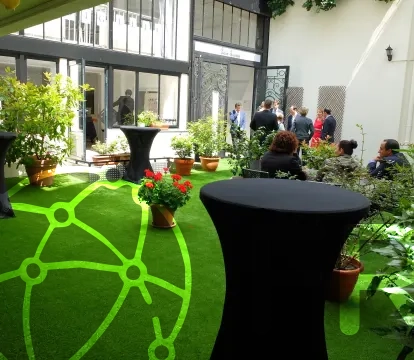 Along with, of course, the results of the elections for the new board members. Voting will open shortly.
  Photo gallery
© FRNIX – The Interconnection Community
