
From the outset, the architecture of the Internet was designed to be distributed and resilient. However, an analysis of the geographical distribution of network infrastructures in France reveals a very different reality: a hyper-concentration in the Paris region that raises serious questions about the technical and economic resilience of our digital ecosystem.
An unprecedented study of the 1,855 French Autonomous Systems (ASNs) registered with RIPE NCC [1] highlights a striking territorial imbalance. At a time when regional Internet Exchange Points (IXPs) are trying to mesh the territory, this X-ray highlights the strategic importance of local peering.
What is an ASN?
Before getting to the heart of the matter, a brief technical diversions is in order. The Internet is not a single, monolithic network: it is a federation of tens of thousands of independent networks, each identified by an Autonomous System Number (ASN). In practical terms, an Autonomous System (AS) refers to any IP network placed under a common routing policy and managed by a single administrative entity - be it a telecoms operator, an Internet Service Provider (ISP), a hosting provider, a large company, a university or a local authority.
Each ASN is a unique number allocated by the Regional Internet Registries (RIRs). In Europe, it is distributed by the RIPE NCC (Réseaux IP Européens Network Coordination Centre). The ASN is the identity of a network on the global routing scene: it is how an operator can announce to the rest of the Internet the blocks of IP addresses it manages, via the BGP (Border Gateway Protocol), the routing protocol that ensures the consistency of the Internet's global «map».
| Who can obtain an ASN? | Concrete examples |
| Telecom operators and ISPs | Orange (AS3215), OVEA (AS29608), SFR (AS15557) |
| Hosting and data centres | OVHcloud (AS16276), Scaleway (AS12876) |
| Large companies | Airbus, BNP Paribas, SNCF |
| SME/SMI | ArtPrice (AS20672), SAB System (AS210684) OL Groupe (AS201900) |
| Universities and public bodies | Renater (AS2200), CNRS |
| Local authorities and regional players | Certain digital initiative syndicates |
Owning its own ASN confers routing autonomy: the entity can choose its traffic routing paths, negotiate peering agreements directly with other networks, and no longer depend on a single transit provider. It is, in a way, moving from the status of tenant to that of owner in the Internet ecosystem. The number of DSAs in a given territory is therefore a relevant indicator of the maturity, diversity and resilience of its digital infrastructure.
Île-de-France, the nerve centre (and a weak point) of the network
The data is indisputable. Of the 1,855 ASNs allocated to French organisations, almost half (48.9 %) are based in the Île-de-France region.
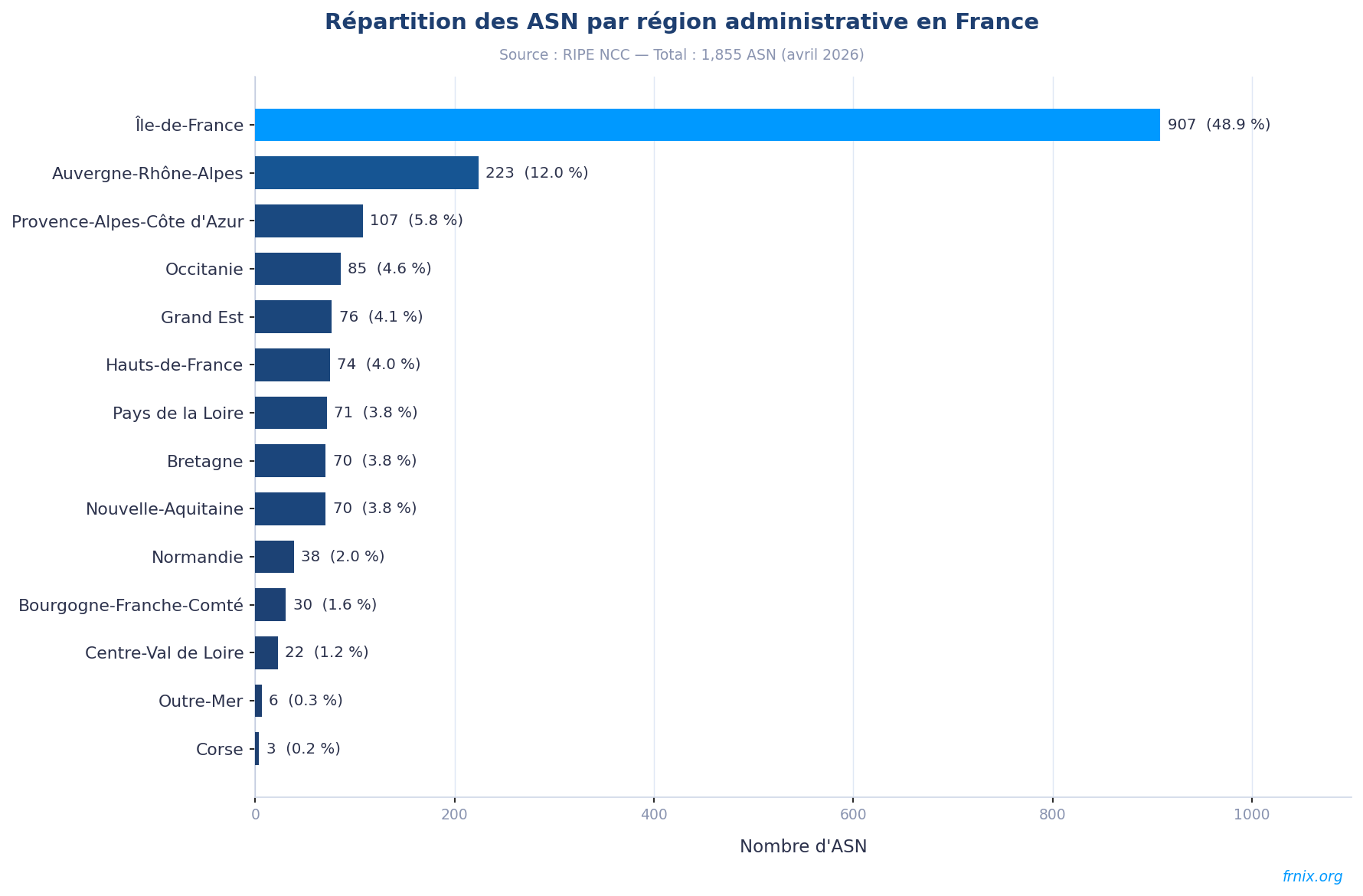
| Administrative region | Number of ASN | Percentage |
| Île-de-France | 907 | 48,9 % |
| Auvergne-Rhône-Alpes | 223 | 12,0 % |
| Provence-Alpes-Côte d'Azur | 107 | 5,8 % |
| Occitania | 85 | 4,6 % |
| Great East | 76 | 4,1 % |
| Hauts-de-France | 74 | 4,0 % |
| Pays de la Loire | 71 | 3,8 % |
| New Aquitaine | 70 | 3,8 % |
| Brittany | 70 | 3,8 % |
| Normandy | 38 | 2,0 % |
| Burgundy-Franche-Comté | 30 | 1,6 % |
| Centre-Val de Loire | 22 | 1,2 % |
| Overseas territories | 6 | 0,3 % |
| Corsica | 3 | 0,2 % |
| Not identified / Address incomplete | 73 | 3,9 % |
Far behind, the Auvergne-Rhône-Alpes (12 %) and Provence-Alpes-Côte d'Azur (5.8 %) regions are trying to act as secondary hubs, buoyed by the dynamism of Lyon and the strategic role of Marseille as a landing hub for submarine cables.
What's even more worrying is that 10 French départements have absolutely no ASN on their territory (Ariège, Dordogne, Loir-et-Cher, Haute-Marne, Meuse, Nièvre, Haute-Saône, Tarn-et-Garonne, Guyane and Mayotte).
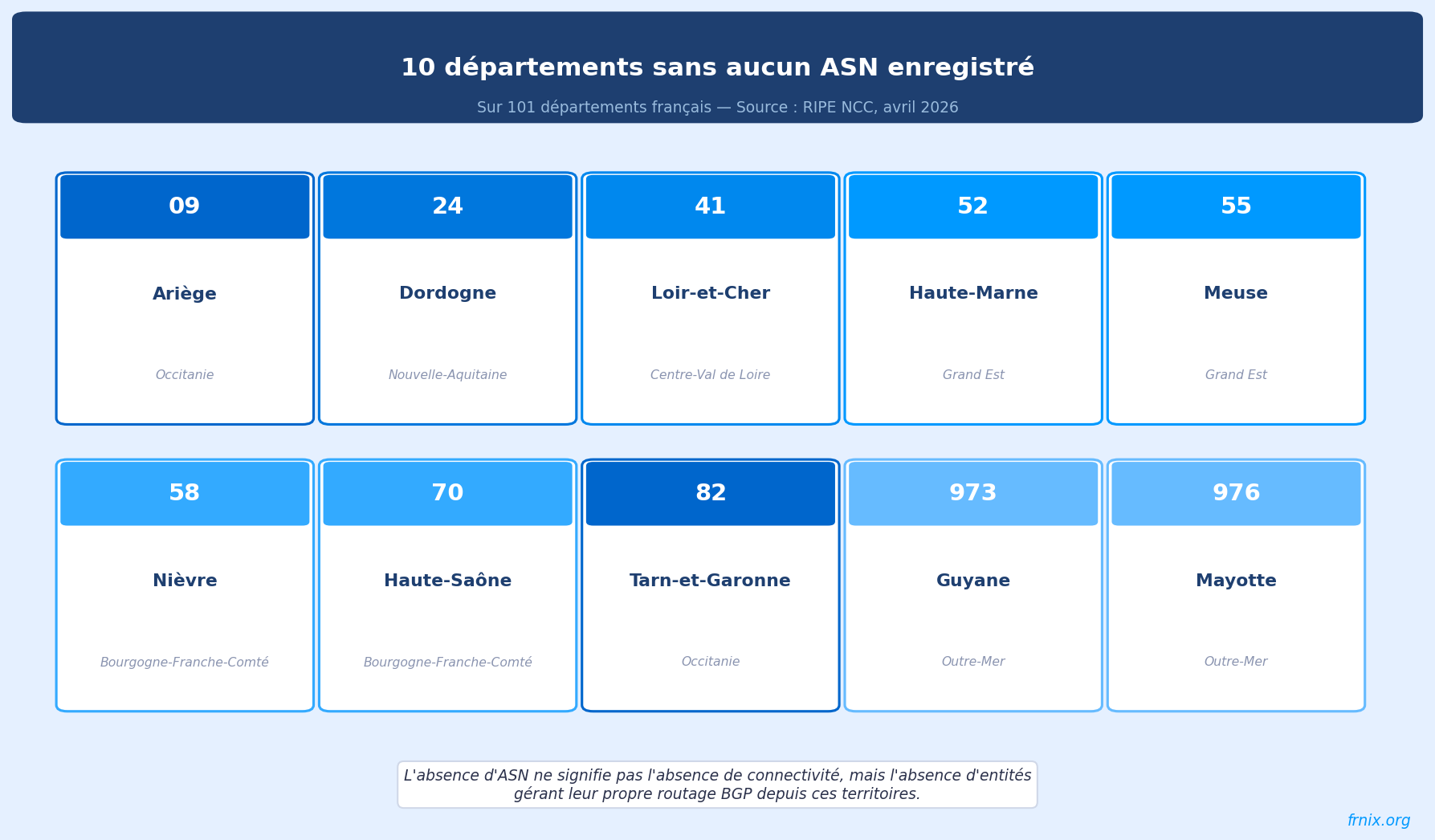
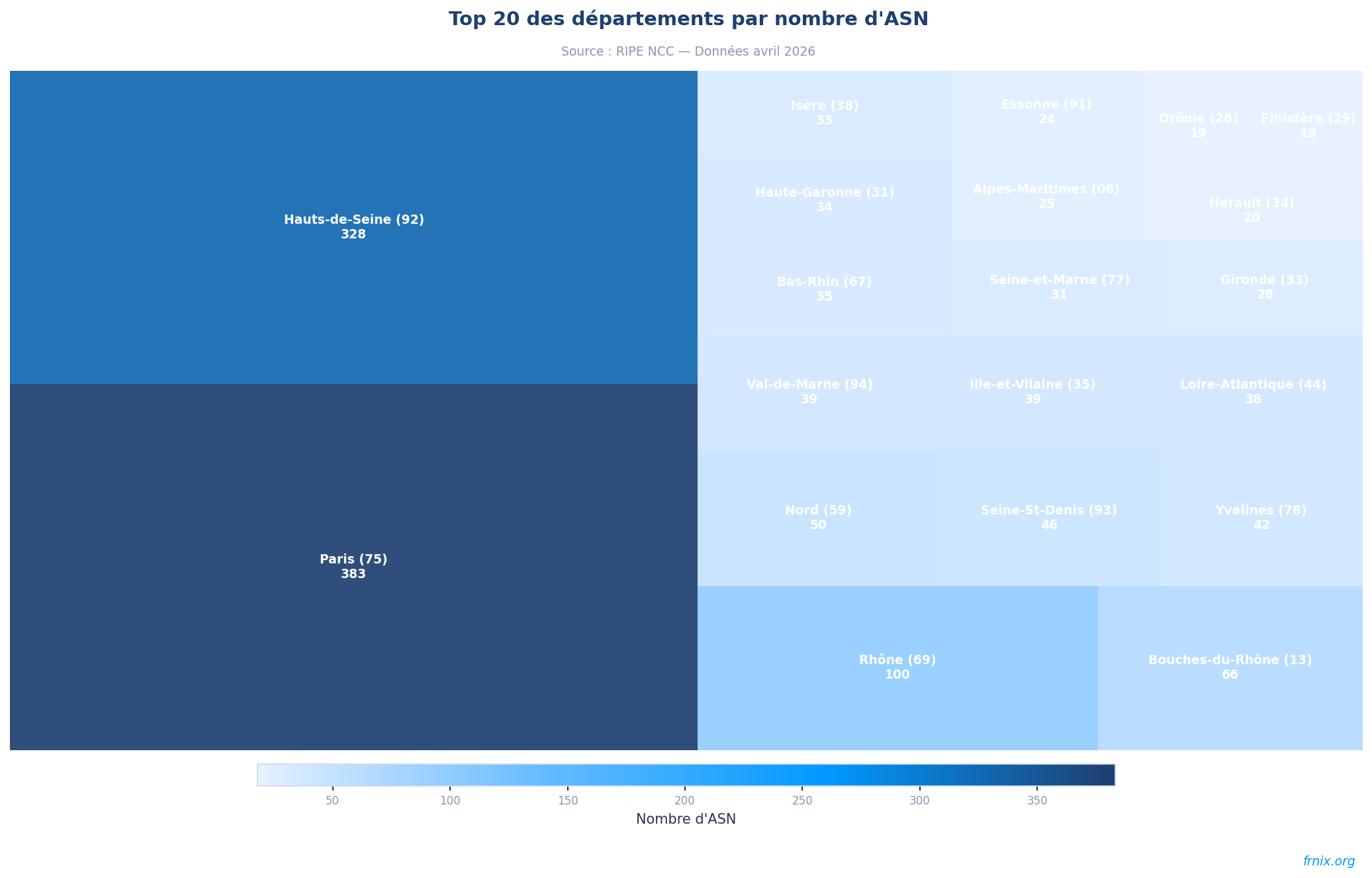
While the absence of an ASN obviously does not mean a lack of Internet connectivity for citizens in these areas, it does reflect an economic reality: operators, hosting providers and companies deploying networks in these areas manage their BGP routing from decision centres located elsewhere. As a result, local traffic is forced to travel back and forth to Paris or other major cities, mechanically increasing latency and dependency on national transit routes.
Is France lagging behind its European neighbours structurally?
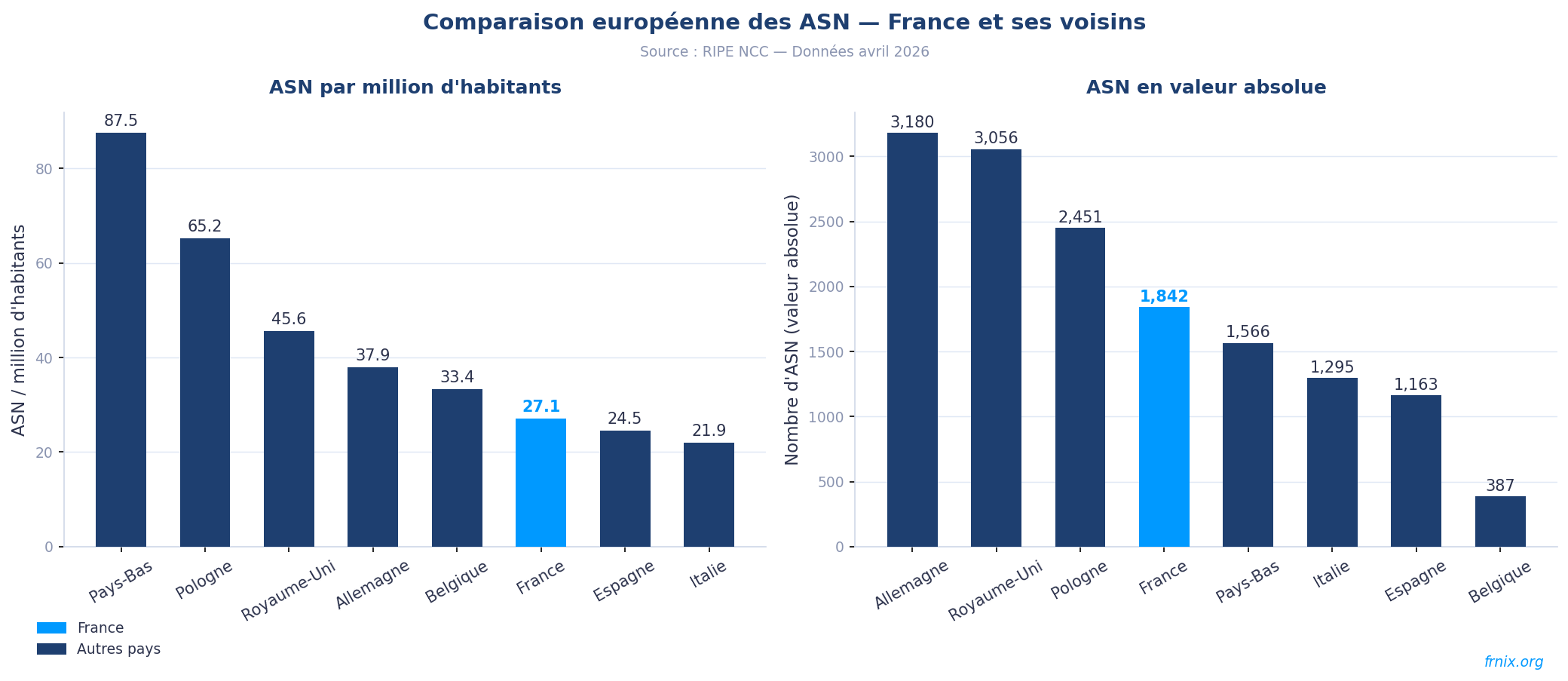
To understand the scale of this phenomenon, we need to look beyond our borders. According to data from the RIPE NCC zone [2], France ranks 6th in Europe in terms of the absolute number of ASNs (1,842), behind Russia, Germany, the United Kingdom, Poland and Ukraine.
However, in relation to its population, the dynamism of the French network ecosystem raises questions. With around 27 ASNs per million inhabitants, France is well behind Germany (almost 38 ASNs/million inhabitants), the UK (45 ASNs/million inhabitants) and above all the Netherlands (over 87 ASNs/million inhabitants).
This difference is partly explained by the culture of peering and decentralisation. Germany, a federal state, benefits from a network of data centres and network players spread across several strong economic centres (Frankfurt, Munich, Hamburg, Berlin). In France, the Jacobin tradition seems to have been transposed to network architecture, concentrating investment, skills and infrastructure around the capital.
Regional peering: a technical and economic necessity
Faced with this hyper-concentration, the development of regional IXPs no longer appears to be a simple optimisation option, but a strategic necessity.
As the FRNIX association, which brings together interconnection players in France, points out [3], IXPs act as a shock absorber in times of crisis. By enabling networks to exchange traffic locally, they reduce dependence on long-distance transit routes.
«IXPs reduce dependence on long-distance transit routes. By enabling networks to exchange data locally, they bring both latency gains and a structural advantage: autonomy. In the event of a crisis (war, disaster), this autonomy becomes resilience». - Antonio Prado [4]
France currently has 19 active IXPs, with over 730 members [5]. Initiatives such as Breizh-IX in Brittany, Ouest.Network in Nantes and Lillix in Hauts-de-France demonstrate that it is possible to create viable local ecosystems. These infrastructures keep local traffic local: an e-mail sent from Rennes to a server hosted in Rennes has no technical reason to transit through Paris.
Towards a rebalancing of the French Internet
The challenge over the next few years will be to encourage the creation of new Autonomous Systems in the regions. For medium-sized businesses, local authorities and universities, obtaining their own ASN and advertising their own IP prefixes is the first step towards digital independence.
This requires an effort to educate and train, tasks that players such as FRNIX are carrying out through its BGP workshops and regional events. The decentralisation of the French Internet cannot be decreed; it must be built router by router, BGP session by BGP session, by bringing data closer to its end users.
The resilience of our national infrastructure will depend on our ability to transform this centralised spider's web into a truly meshed, robust and distributed network.
